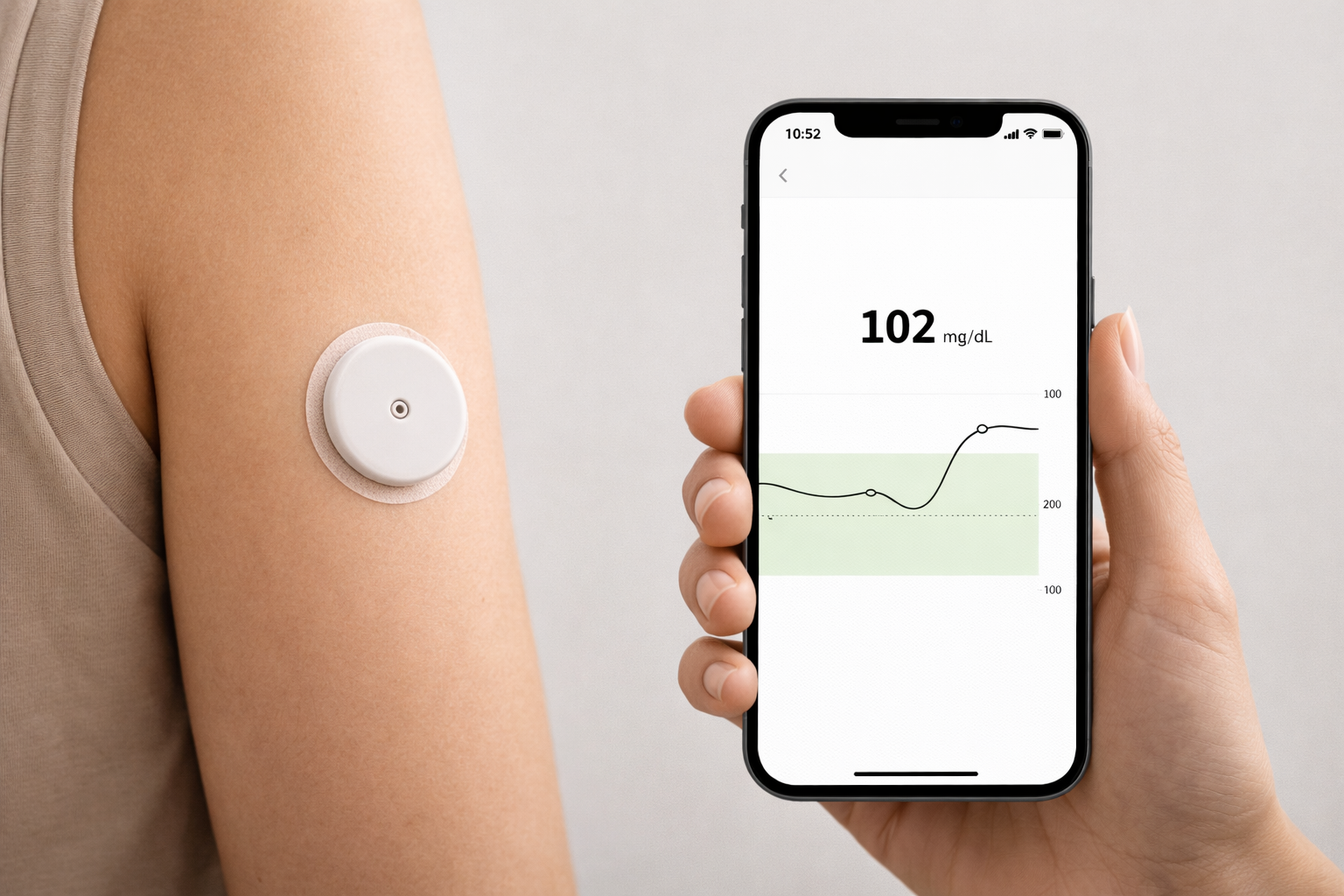
CGM for Non-Diabetics : Are “Glucose Spikes” Being Overhyped?
Quick Summary
Continuous glucose monitors (CGMs) are no longer just for diabetes management. More non-diabetic people are using them for “metabolic health,” weight loss, longevity, and performance. That rise has also popularized a simple message: glucose spikes = harmful.
The problem is that this message is often too simplified. In a non-diabetic body, it’s normal for glucose to rise after meals. A post-meal bump doesn’t automatically mean you’re “damaging your health” or “aging faster.” Without clinical context, CGM data can be misread—leading to unnecessary food fear, extreme restriction, under-fueling (especially in active people), or a false sense of “control” that replaces real health fundamentals.
This post breaks down what CGMs can (and can’t) tell non-diabetics, why “spike obsession” is getting overhyped, and how using a CGM without medical guidance can backfire. You’ll also get safer ways to interpret trends and make changes that actually stick.
Table of Contents
- Key Takeaways
- What a CGM Measures (and What It Doesn’t)
- Why Non-Diabetic CGM Use Is Surging
- Are “Glucose Spikes” Being Overhyped?
- How CGM Use Can Backfire Without Clinician Guidance
- A Smarter Way to Interpret CGM Data
- Practical Moves That Reduce Big Swings (Without Food Fear)
- Pros vs Cons: One-Page Decision Table
- 14-Day “Responsible CGM” Plan for Non-Diabetics
- FAQ
- Blog Optimization Info
Key Takeaways
- A glucose rise after eating is normal—especially in non-diabetics. “Spike = evil” is an oversimplification.
- CGMs measure glucose in interstitial fluid, not directly in blood. There is a lag and occasional sensor noise.
- One reading rarely matters. Trends, patterns, and your overall context matter more than any single bump.
- Without guidance, CGMs can worsen eating anxiety, encourage overly restrictive dieting, and create misleading “rules.”
- If you’re using a CGM, use it like a tool—not a judge. Define a goal, run a short experiment, learn, and stop.
Health note: This article is general information and not medical advice. If you have symptoms of blood sugar problems, a history of eating disorders, are pregnant, or take medications that affect glucose, consult a clinician before relying on CGM data.
What a CGM Measures (and What It Doesn’t)
A CGM continuously estimates glucose levels in the fluid between your cells (interstitial fluid). This is incredibly useful for seeing direction and patterns—but it’s not the same as a lab blood test.
- There’s a time lag: CGM readings can trail rapid changes compared to blood glucose.
- There’s measurement noise: Compression (lying on the sensor), hydration status, temperature, and sensor variability can affect readings.
- Context is missing: A CGM doesn’t know your sleep, stress, workout intensity, menstrual cycle phase, illness, or medication use—yet all of those can shift glucose behavior.
Bottom line: CGMs are great for pattern awareness, but they are not a morality meter, and they’re not a standalone diagnostic tool for non-diabetics.
Why Non-Diabetic CGM Use Is Surging
Three factors have made CGMs more popular outside diabetes care:
- Wearable culture: People now track steps, sleep, heart rate, HRV—glucose feels like the “next frontier.”
- Longevity + optimization marketing: Glucose graphs look actionable and “sciencey,” which makes them easy to sell.
- Simple storytelling: “Avoid spikes to avoid aging” is a clean narrative—even if physiology is more complex.
This isn’t inherently bad. The risk appears when the story becomes: every rise is dangerous, and the only solution is aggressive restriction.
Are “Glucose Spikes” Being Overhyped?
In non-diabetics, post-meal rises are part of normal metabolism. Your body increases insulin to move glucose into cells, and levels come back down. A “spike” on your graph can simply mean you ate carbohydrate—especially quickly, without much fiber, protein, or fat.
Why “spike = bad” is an oversimplification
- Magnitude matters less than pattern: Occasional bumps are different from sustained elevations or consistently extreme swings.
- Meal context matters: A spike after a high-carb meal can be normal—especially if you’re active or replenishing glycogen.
- Stress and sleep can mimic food effects: A rough night can raise glucose responses even if you ate “the same” meal.
- Chasing flat lines can be unhealthy: If you try to eliminate every rise, you can end up under-eating, avoiding nutrient-dense foods, or fueling workouts poorly.
What “glucose spikes” can signal (sometimes)
CGM patterns can be useful when they reveal:
- Specific trigger meals that cause unusually large or prolonged rises for you
- Hidden behavior factors (late-night eating, alcohol, skipped meals leading to rebound overeating)
- Possible metabolic risk when paired with symptoms and clinical labs (this is where clinician guidance matters)
How CGM Use Can Backfire Without Clinician Guidance
Using a CGM without support can create unintended problems. Here are the most common “reverse effects”:
1) Food fear and “orthorexia by graph”
If every bump becomes a threat, you may start avoiding foods you previously tolerated—fruit, legumes, whole grains, even dairy—despite them being nutritious for many people. Over time, this can shrink your diet and increase anxiety around eating.
2) Over-correcting with extreme restriction
Some users respond by going very low-carb without considering energy needs, fiber intake, training demands, or sustainability. The result can be fatigue, cravings, binge-restrict cycles, or poor workout recovery.
3) Misinterpreting sensor artifacts as “biological failure”
Compression lows, sensor variability, and day-to-day changes can lead people to conclude they’re “getting worse” when it’s simply device noise or normal variability.
4) Replacing medical evaluation with self-experimentation
CGMs can create false reassurance (“my graph looks okay, so I’m fine”) or false alarm (“my graph looks scary, so I must be sick”). If you truly suspect a problem, validated labs and clinician interpretation are the right next step.
5) Ignoring the biggest levers
People can spend hours optimizing micro-spikes while ignoring basics that often matter more: sleep duration, strength training, overall diet quality, stress management, and consistent movement.
A Smarter Way to Interpret CGM Data
If you’re non-diabetic and wearing a CGM, aim for pattern learning, not perfection.
Think in “questions,” not rules
- Which meals cause the biggest rises for me?
- Does adding fiber/protein change the curve?
- Does a 10–15 minute walk after dinner change my overnight trend?
- Do I react differently when I’m stressed, sleep-deprived, or sedentary?
Use “repeat tests” before drawing conclusions
If one meal looks dramatic, repeat it on a different day under similar conditions. If it consistently produces the same pattern, you’ve learned something. If not, it may have been context, stress, timing, or sensor noise.
Pair CGM insights with reality checks
- How’s your energy, hunger, mood, and training recovery?
- Are you sleeping well?
- Are you getting enough protein and fiber overall?
If the CGM “improvement” comes with worse energy or more food anxiety, that’s not a health win.
Practical Moves That Reduce Big Swings (Without Food Fear)
- Build the plate: start meals with veggies (fiber) + protein, then add carbs—especially for refined carbs.
- Slow down the first 5 minutes: eating speed changes curves more than most people expect.
- Post-meal movement: 10–15 minutes of easy walking after your largest carb meal often helps.
- Upgrade carbs rather than erase them: choose minimally processed carbs more often, and combine with protein/fiber.
- Sleep is a glucose tool: poor sleep can exaggerate responses the next day.
- Don’t drink “naked carbs” at night: sweet drinks and desserts close to bedtime can be a common driver of big swings for many people.
Pros vs Cons: One-Page Decision Table
| What You Want | CGM Can Help If… | Where It Can Go Wrong | Better First Move |
|---|---|---|---|
| Understand personal food responses | You treat it as a short experiment with repeat tests | You overreact to one-off spikes or device noise | Simple food log + post-meal walk test |
| Weight management | You use it to reduce late-night grazing and improve meal balance | You go extreme, under-eat, or increase food anxiety | Protein/fiber targets + consistent activity |
| Longevity / “metabolic health” | You focus on trends + basics (sleep, muscle, movement) | You chase flat lines and ignore bigger levers | Strength training + sleep regularity |
| Rule out a health issue | Not ideal alone | False reassurance or unnecessary panic | Clinician visit + validated labs |
14-Day “Responsible CGM” Plan for Non-Diabetics
- Day 1: Define your goal
Pick one: meal balance, evening cravings, performance fueling, or general awareness. A CGM is most useful when you’re answering a specific question. - Days 2–3: Establish a baseline
Eat normally and observe. Don’t “behave better” just because you’re monitored. You need honest data first. - Days 4–6: Run one experiment
Example: same breakfast, but add protein/fiber first. Or add a 10–15 minute walk after dinner. Compare patterns. - Days 7–9: Repeat-test your “trigger meal”
If a meal consistently causes a large rise, try a gentle modification (portion, order, fiber, protein) rather than banning it. - Days 10–12: Address the big levers
Improve sleep timing, add daily movement, and reduce late-night “naked carbs.” Watch how trends shift. - Days 13–14: Decide whether to stop
If you’ve learned actionable insights, consider removing the CGM and living the habits. Continuous monitoring isn’t always healthier.
Copy-Paste CGM Experiment Log
Date:
Sleep (hours/quality):
Stress (low/med/high):
Training (none/light/moderate/hard):

Meal tested:

* What I ate:
* Eating speed (slow/normal/fast):
* Order (veggies/protein first? yes/no):
* Post-meal movement (none/10 min walk/other):

Outcome (simple):

* Peak felt (small/medium/large):
* How long it stayed elevated (short/medium/long):
* Energy/hunger 2–3 hours later:
* Notes (alcohol, illness, cycle, travel, etc.):
FAQ
Do non-diabetics “need” a CGM?
Most non-diabetics do not need a CGM for good health. It can be educational for a short window, but it is not required—and it’s not automatically beneficial.
Is it bad if my glucose rises after eating?
Not necessarily. A rise after meals is normal physiology. The meaningful question is your overall pattern, symptoms, and whether you’re improving habits that support long-term health.
Can CGM use cause harm?
It can—mainly by increasing anxiety, driving overly restrictive eating, and replacing real medical evaluation or foundational habits with constant micromanagement.
When should I talk to a clinician?
If you have concerning symptoms (unusual fatigue, frequent urination/thirst, unexplained weight change), a strong family history, or persistent concerning patterns—especially if you feel unsure—clinical evaluation is the right next step.
이 포스팅은 쿠팡 파트너스 활동의 일환으로, 이에 따른 일정액의 수수료를 제공받습니다.
'Trend Check' 카테고리의 다른 글
| “More Protein Is Always Better” — Myth, Context, and Practical Targets (1) | 2025.12.28 |
|---|---|
| Sleep Hacks on Social Media: Which Ones Are Legit, Which Ones Aren’t? (0) | 2025.12.28 |
| Cold Plunges & Ice Baths : Benefits vs Heart Risks (0) | 2025.12.27 |
| The “Cortisol Cocktail” / Adrenal Drink : What It Can (and Can’t) Do (1) | 2025.12.27 |
| Mouth Taping for Sleep : Helpful Hack or Hidden Risk? (0) | 2025.12.27 |


