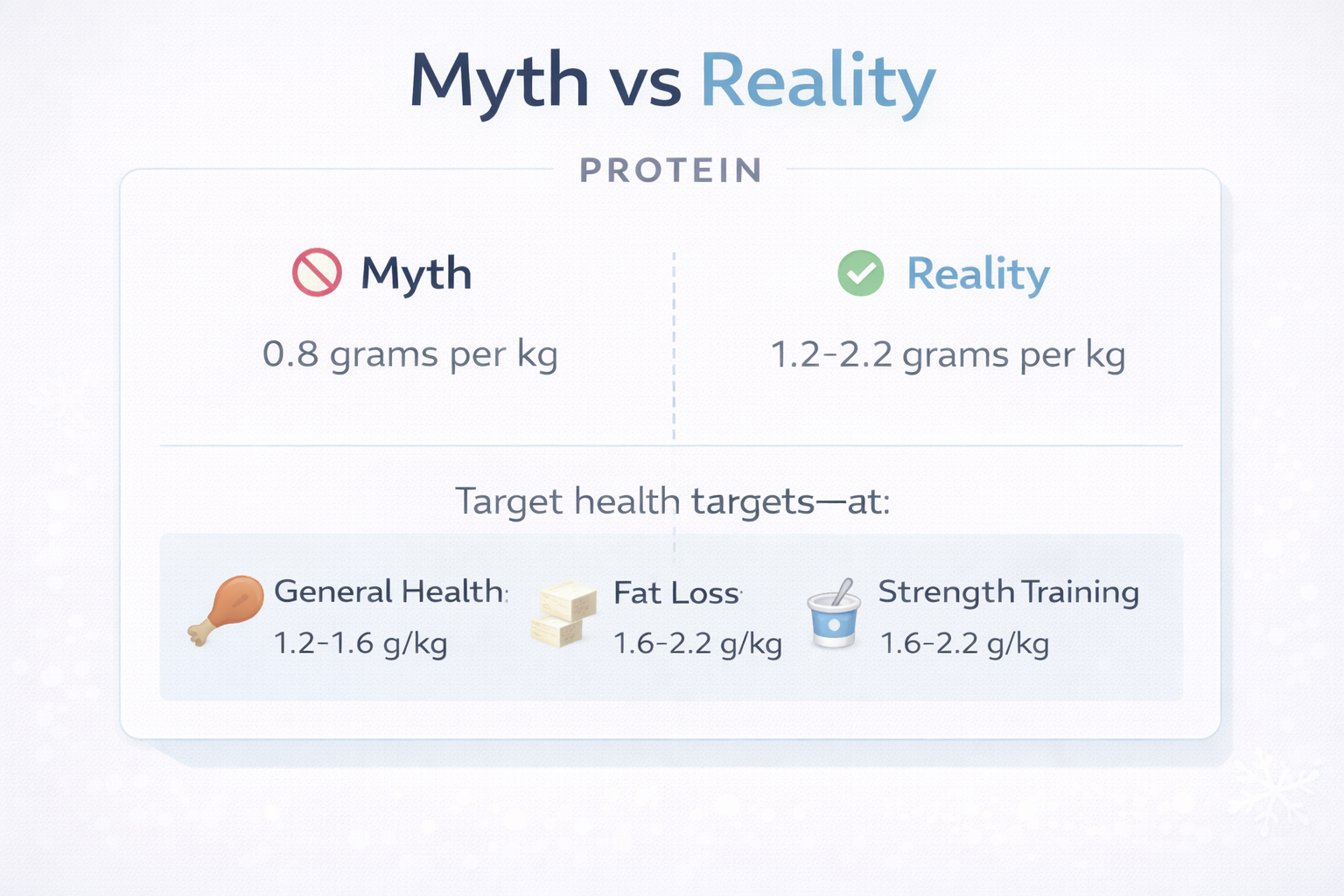
“More Protein Is Always Better” — Myth, Context, and Practical Targets
Disclaimer: This article is for general education and does not replace medical advice. If you have kidney disease, liver disease, uncontrolled diabetes, a history of eating disorders, or you are pregnant/breastfeeding, discuss major diet changes with a qualified clinician.
Quick Summary
The internet loves a simple rule: “Protein is good, therefore more protein is always better.” The reality is more nuanced. Protein supports muscle maintenance, recovery, satiety, and healthy aging, but the “right” amount depends on your body size, activity level, goals (fat loss vs muscle gain), and health status. Past a certain point, adding more protein often gives diminishing returns, crowds out other important nutrients, and can turn eating into a stressful numbers game. The best approach is to aim for a practical target range, distribute protein across meals, and choose mostly minimally processed protein sources while keeping the rest of your diet balanced.
Table of Contents
- The Myth and Why It’s So Persuasive
- What Protein Actually Does (Without the Hype)
- Context That Changes the Answer
- Practical Protein Targets (Simple Ranges)
- Per-Meal Targets and Distribution
- When Higher Protein Helps (And When It Doesn’t)
- Common Pitfalls and Who Should Be Cautious
- How to Hit Your Target Without Living on Shakes
- Sample Day Templates (Three Styles)
- FAQ: The Questions Everyone Asks
- Blog Optimization Info
The Myth and Why It’s So Persuasive
“More protein is always better” spreads easily because it’s partly true and very marketable. Many people under-eat protein relative to their goals, and increasing protein can improve satiety and help preserve muscle during fat loss. So the message feels like a universal fix. But what starts as “protein is important” turns into “protein is the only macro that matters,” and then into “the highest number wins.” That’s where the myth breaks down.
Here’s the more accurate version: Protein has a sweet spot. Below that range, you may compromise muscle maintenance and hunger control. Inside the range, you get most of the benefits. Beyond the range, additional gains are often smaller, and trade-offs rise.
What Protein Actually Does (Without the Hype)
Protein is not magic, but it is uniquely useful. In practical terms, it helps with four major things:
- Muscle maintenance and repair: Muscle tissue is constantly turning over, and dietary amino acids support that process, especially when training creates a stimulus to rebuild.
- Satiety: Higher-protein meals often keep you fuller for longer, which can make calorie control easier.
- Performance and recovery support: Adequate protein supports adaptation to resistance training and helps you recover from hard sessions.
- Healthy aging: As we age, preserving lean mass becomes more important for mobility, independence, and metabolic health.
Notice what’s not on the list: “Automatically makes you lean,” “guarantees muscle gain,” or “lets you ignore sleep, training, and total calories.” Protein is a powerful supporting actor, not the whole movie.
Context That Changes the Answer
Before you set a target, you need to know which “version of you” you’re feeding. The same intake can be perfect for one person and unnecessary for another.
- Your goal: Fat loss, muscle gain, maintenance, or endurance performance each shift the ideal range.
- Your training: Protein works best when paired with resistance training; without a training stimulus, “extra” protein is less likely to translate into meaningful changes.
- Your body size and leanness: Larger bodies generally need more total grams; very lean people gaining muscle may benefit from higher intakes than someone at a higher body fat percentage with the same scale weight.
- Your age: Older adults often benefit from slightly higher and more evenly distributed protein to support muscle maintenance.
- Your appetite and preferences: If a target is miserable to follow, it won’t work, even if it’s theoretically “optimal.”
- Your health status: People with certain medical conditions should not treat social-media targets as a default.
Practical Protein Targets (Simple Ranges)
Below is a practical table that gives you ranges you can actually implement. It’s intentionally conservative and flexible, because consistency beats perfection.
| Person / Goal | Daily Target Range | Simple Rule | Notes |
|---|---|---|---|
| General health, lightly active | ~1.0–1.2 g/kg/day | Protein at 3 meals | Great baseline if you’re not training hard but want solid nutrition. |
| Fat loss (dieting) | ~1.2–1.6 g/kg/day | Protein every meal + snack | Helps satiety and lean mass retention while calories are lower. |
| Strength training (build/maintain muscle) | ~1.6–2.2 g/kg/day | 4 “protein hits” per day | Most evidence-based “muscle range”; higher is not automatically better. |
| Older adults (muscle maintenance) | ~1.2–1.6 g/kg/day | Protein evenly distributed | Prioritize per-meal protein and resistance training for best results. |
| Endurance-heavy training | ~1.2–1.8 g/kg/day | Protein + carbs together | Don’t crowd out carbs; performance often suffers if carbs are too low. |
If you don’t want to do math: Use a per-meal approach: aim for a solid protein portion at each meal and one additional protein-focused snack if you’re training hard or dieting.
Per-Meal Targets and Distribution
One of the most common “high protein” mistakes is front-loading everything into one meal (or trying to drink half your day’s protein in a single shake). A better approach is consistent distribution across the day.
- Most adults: 25–40 g protein per meal, 3 meals per day.
- Training hard or dieting: Add a fourth protein “hit” (a snack or smaller meal) with 20–35 g protein.
- Older adults: Err toward the higher end per meal and keep distribution even.
Think of it as “repeatable” rather than “maximal.” If your protein target requires heroic behavior, it’s probably too high for your current lifestyle.
When Higher Protein Helps (And When It Doesn’t)
Higher protein often helps when:
- You are in a calorie deficit (fat loss phase) and hunger is a problem.
- You’re lifting weights consistently and want to gain or preserve muscle.
- You are older and want to support lean mass maintenance.
- You have a history of under-eating protein (common with convenience-heavy diets).
Higher protein often does not help much when:
- You are not doing resistance training and expect protein alone to build muscle.
- You already hit a solid range consistently and are pushing higher “just because.”
- Increasing protein forces you to cut fruits, vegetables, fiber, or carbs that support performance and overall health.
- Your high-protein strategy relies mostly on ultra-processed “protein everything” foods that displace a balanced diet.
Practical reality: If you are already around the middle of a reasonable range and your training, sleep, and total calories are not aligned with your goal, increasing protein further is rarely the lever that changes everything.
Common Pitfalls and Who Should Be Cautious
Protein is generally safe for healthy people within reasonable ranges, but “high protein culture” can create predictable problems.
- Crowding out other nutrients: If more protein means fewer vegetables, less fiber, or too few carbs for your training, you may feel worse even if your protein number looks impressive.
- Ultra-processed protein overload: Bars, cookies, chips, and sweetened shakes can help in a pinch, but building your diet around them often increases additives, sodium, and calories while reducing micronutrient density.
- Digestive issues: Many people experience bloating or constipation when they raise protein without raising fluids and fiber.
- “Protein anxiety” and tracking fatigue: Constantly chasing a number can increase stress, which ironically can worsen sleep, recovery, and consistency.
- Medical context matters: People with kidney disease, significant kidney impairment, or specific metabolic conditions should not self-prescribe very high protein targets.
How to Hit Your Target Without Living on Shakes
The easiest way to hit a protein target is to build meals around “protein anchors,” then add carbs, fats, and plants around them.
Protein anchors (choose one per meal)
- Animal-based: eggs, Greek yogurt, cottage cheese, chicken, turkey, lean beef, fish, shrimp.
- Plant-based: tofu, tempeh, edamame, lentils, beans (often best paired or portioned larger), soy yogurt, seitan (if tolerated).
Simple plate template
- 1 protein anchor (the center of the plate).
- 1–2 fists of plants (vegetables and/or fruit).
- 1 cupped hand of carbs (more if you train hard; less if you’re sedentary and dieting).
- 1 thumb of fats (olive oil, nuts, avocado) as needed for taste and satiety.
Shakes: a tool, not a lifestyle
Protein shakes can be convenient, especially post-workout or on busy mornings. But if your entire strategy depends on liquid calories, it can make your diet less satisfying and less nutrient-dense. A good rule: use shakes to fill gaps, not to replace most meals.
Sample Day Templates (Three Styles)
Template A: General health (3-meal structure)
- Breakfast: Greek yogurt bowl (yogurt + fruit + nuts) or eggs with toast and fruit.
- Lunch: Big salad with chicken/tofu + beans + olive oil dressing; add rice or bread if needed.
- Dinner: Fish/chicken/tofu + vegetables + potatoes/rice; finish with fruit.
Template B: Fat loss (3 meals + protein snack)
- Breakfast: Omelet or protein-rich yogurt; keep it high-satiety.
- Lunch: Lean protein bowl (chicken/turkey/tofu) + lots of vegetables + moderate carbs.
- Snack: Cottage cheese, a protein shake, or edamame.
- Dinner: Protein + vegetables + a controlled carb portion; prioritize fiber.
Template C: Strength training (4 protein hits)
- Meal 1: Protein-focused breakfast (eggs or yogurt + oats).
- Meal 2: Protein lunch (chicken/tofu bowl).
- Meal 3: Post-workout protein (food or shake) with carbs.
- Meal 4: Protein dinner (fish/lean meat/tempeh) + vegetables + carbs as needed.
FAQ: The Questions Everyone Asks
Is it possible to eat “too much” protein?
For most healthy people, moderate-to-high protein in a sensible range is fine. The more common issue is not toxicity, but trade-offs: too few carbs for training, not enough fiber, too much reliance on processed products, or simply an intake that is hard to sustain.
Should I base protein on body weight or goal weight?
For many people, actual body weight works fine for setting a reasonable range. If you have a lot of body weight to lose and the numbers get extreme, using a range tied to a more realistic target body weight can make targets more practical. When in doubt, choose a middle range you can consistently hit and adjust based on results and how you feel.
Do I need protein immediately after a workout?
Timing matters less than total daily intake and consistent distribution. If you train and won’t eat for many hours, a convenient protein option can help. But you don’t need to panic if you miss a narrow “anabolic window.”
Are plant proteins “worse”?
Not worse, but sometimes different in density and structure. Many plant protein sources come packaged with fiber and carbs, which can be great for health and satiety, but it may take larger portions to reach higher protein targets. A smart approach is using concentrated plant proteins (tofu, tempeh, soy yogurt, seitan if tolerated) and combining legumes with other protein sources across the day.
What is the simplest “legit” protein hack?
Pick one meal you routinely under-protein (often breakfast) and upgrade it. A consistent breakfast protein upgrade often improves appetite control for the rest of the day without any complicated tracking.
이 포스팅은 쿠팡 파트너스 활동의 일환으로, 이에 따른 일정액의 수수료를 제공받습니다.


