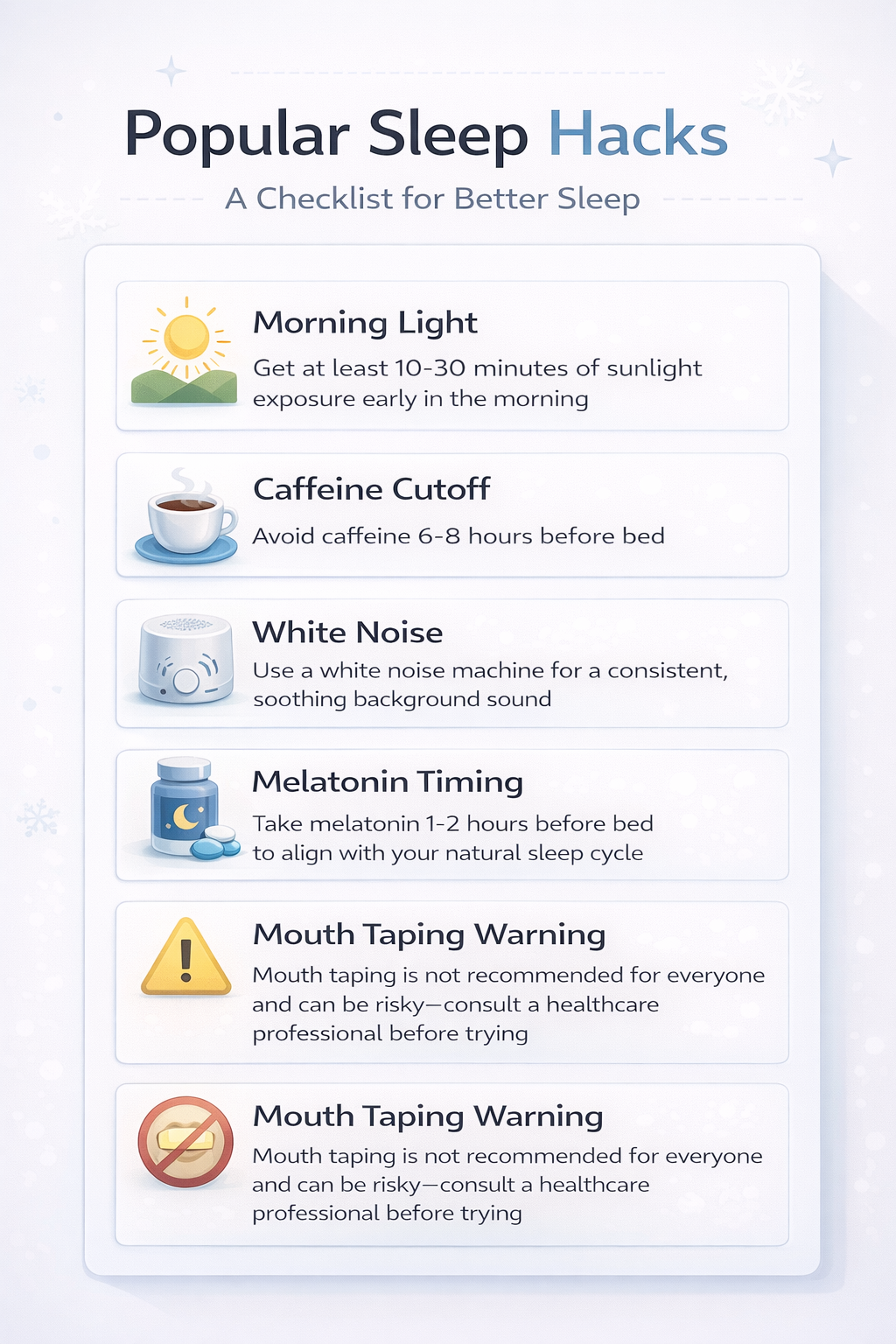
Sleep Hacks on Social Media: Which Ones Are Legit, Which Ones Aren’t?
Disclaimer: This article is for general education only and does not replace medical advice. If you have severe insomnia, excessive daytime sleepiness, loud snoring, witnessed breathing pauses, chest pain, or a mental health crisis, seek professional care promptly.
Quick Summary
Social media sleep content can be surprisingly helpful, but it also mixes real physiology with half-truths and “one weird trick” marketing. The most reliable sleep improvements usually come from boring basics that reduce sleep disruption: consistent wake time, morning light, managing caffeine and alcohol, a calmer wind-down, and a cooler, darker bedroom. The least reliable hacks are the ones that promise instant results, ignore your personal context (stress, shift work, kids, medical issues), or push risky behaviors like mouth taping without medical screening. In this guide, you’ll get a simple framework to judge any sleep hack, a clear “legit vs questionable vs avoid” breakdown, and a ready-to-use plan to improve sleep without turning your bedtime into a science project.
Table of Contents
- A Simple Framework to Judge Any Sleep Hack
- Legit Sleep Hacks That Actually Help Most People
- “It Depends” Hacks: Useful for Some, Not for Others
- Not Legit or Risky Hacks to Avoid
- Fast Verdicts on the Most Viral Sleep Trends
- A 7-Day “No Drama” Sleep Upgrade Plan
- When to Stop Hacking and Get Help
- Blog Optimization Info
A Simple Framework to Judge Any Sleep Hack
Before you try anything, run it through four questions. This keeps you from wasting money, confusing your body, or doing something unsafe.
| Question | What to Ask | Practical Example |
|---|---|---|
| Safety | Could this harm me or interact with meds/conditions? | Mouth taping can be risky if you might have sleep apnea or nasal obstruction; supplements can interact with medications. |
| Plausibility | Does the mechanism make sense? | Morning light helps your circadian timing; blasting cold plunges at night might energize you instead of calming you. |
| Effort vs payoff | Is it simple enough to do consistently? | Lowering caffeine cutoff is easier than assembling a 12-step bedtime supplement stack. |
| Signal vs noise | Can I tell if it works within 1–2 weeks? | Track sleep onset time, awakenings, and daytime energy; if nothing changes after consistent testing, drop it. |
Rule of thumb: The best sleep hacks improve either your circadian rhythm (timing) or your arousal level (calmness). The worst hacks mainly improve your vibe.
Legit Sleep Hacks That Actually Help Most People
These are the “unsexy” habits that repeatedly show up in real-world sleep improvement. You do not need to do all of them. Pick 2–3 that feel doable and stick with them for 7–14 days.
1) Keep a consistent wake-up time (even on weekends)
If your wake-up time swings wildly, your body clock gets mixed signals, and bedtime becomes unpredictable. A steady wake-up time is often the fastest way to stabilize sleep timing, especially if you struggle to fall asleep.
2) Get bright light early in the day
Morning light tells your brain, “Day has started,” which helps your body produce sleepiness at the right time later. If you work indoors, even a short outdoor walk after waking can help. If mornings are dark where you live, prioritize as much natural light as practical.
3) Move caffeine earlier than you think
Caffeine can linger and quietly sabotage sleep, especially if you’re sensitive or stressed. A practical approach is to set a caffeine cutoff time and test it for a week. If you’re currently drinking caffeine late, shift the cutoff earlier gradually instead of quitting overnight.
4) Treat alcohol like a sleep disruptor, not a sleep aid
Alcohol can make you feel sleepy at first, but many people experience more fragmented sleep later. If you drink, consider moving alcohol earlier in the evening and reducing the amount on nights when sleep matters most.
5) Build a “low-friction” wind-down
Your goal is not a perfect routine; it’s a predictable signal that sleep is coming. Examples: warm shower, reading paper book, light stretching, calm music, or a short breathing exercise. Keep it short and repeatable.
6) Make the bedroom cool, dark, and quiet
Most people sleep better in a cooler environment. Darkness supports sleep timing. Noise control reduces awakenings. If you can’t control noise, consider steady background sound (white noise or a fan). If light is an issue, blackout curtains or an eye mask can help.
7) Reduce “bed = awake time”
If you spend long stretches awake in bed, your brain can learn that the bed is for thinking, scrolling, or worrying. If you’re awake for a long time, it can help to get up briefly and do something calm in dim light, then return to bed when sleepy.
Beginner-friendly shortcut: If you do only two things, do this: keep the same wake time daily and get light exposure early. Many other sleep hacks work better once your timing is stable.
“It Depends” Hacks: Useful for Some, Not for Others
These can be helpful, but they are context-sensitive. Test them thoughtfully, one at a time, so you know what actually helped.
Melatonin
Melatonin is not a knockout pill for everyone. It can be more useful for shifting sleep timing (for example, when your schedule is off) than for instantly forcing sleep. If you try it, many people do better with a small dose and earlier timing rather than taking a large dose right at bedtime. If you are pregnant, have epilepsy, are on blood thinners, or take multiple medications, check with a clinician before using supplements.
Magnesium, glycine, and other “sleep supplements”
Some people feel calmer, others feel nothing, and some get GI side effects. Supplements can also interact with medications. If you test a supplement, change only one variable, keep the dose conservative, and stop if you feel worse.
Weighted blankets
They can feel grounding and reduce restlessness for some people, especially if anxiety is a big sleep driver. If you run hot or have mobility or breathing issues, they may be uncomfortable or not appropriate.
Warm shower or bath before bed
This can support relaxation and help your body transition toward sleep, especially if it becomes part of a consistent routine. If it wakes you up or turns into a late-night task, it’s not worth it.
White noise or “pink noise”
Steady sound can mask sudden noises that cause micro-awakenings. If you share a room, pick a volume that is comfortable and not overly loud, and test for a week.
Not Legit or Risky Hacks to Avoid
Some trends are more about drama than sleep. Others can be genuinely unsafe, especially if you have undiagnosed medical issues.
- Mouth taping without medical screening: If you snore loudly, wake up gasping, have daytime sleepiness, or suspect sleep apnea, do not mouth tape. Sleep apnea is common and serious, and you don’t want to mask symptoms or change breathing patterns without guidance.
- Using alcohol or sedating substances as a “sleep tool”: These may increase sleepiness at first but often worsen sleep quality and can create dependence patterns.
- Extreme sleep restriction challenges: “Sleep less to sleep better” gets misused online. Structured sleep restriction is a clinical insomnia technique with careful rules; doing it randomly can backfire and worsen anxiety and fatigue.
- Stacking multiple supplements at once: If you take five new products, you won’t know what helped or harmed, and you increase interaction risk.
- “Detox” narratives: If a hack relies on vague detox language instead of a clear mechanism, it’s usually marketing, not sleep science.
Safety first: If a sleep hack affects breathing, heart rate, medication, or consciousness, treat it like a medical decision, not lifestyle content.
Fast Verdicts on the Most Viral Sleep Trends
Here are quick, practical takes on hacks you’ve probably seen in clips, reels, or threads. Use these as templates for judging the next viral idea.
| Hack | Verdict | What’s legit about it | Watch out for |
|---|---|---|---|
| “Military sleep method” | Mostly legit | Relaxation and breath-based wind-down can lower arousal and help sleep onset. | Not instant for everyone; it’s a skill that improves with repetition. |
| Blue-light blocking glasses as a magic fix | It depends | Reducing bright light at night can help some people, especially if screens are very bright and close. | Glasses won’t fix caffeine, stress, irregular schedule, or late-night doomscrolling. |
| “Sleepy mocktail” stacks | Questionable | A calming ritual can help; warm, relaxing routines are useful. | Supplement stacking and sugar/alcohol versions can disrupt sleep; results vary widely. |
| Cold plunge or ice bath at night | Often not ideal | Some people find cold exposure mentally calming. | Cold can be stimulating and raise alertness; timing matters; not for everyone. |
| Mouth taping | Risky | Some people aim to reduce mouth breathing. | Do not try if you might have sleep apnea, congestion, or breathing issues; safety concerns. |
| White noise / fan noise | Legit | Can reduce awakenings by masking sudden sounds. | Volume should be comfortable; if it annoys you, it won’t help. |
A 7-Day “No Drama” Sleep Upgrade Plan
This plan is intentionally simple. The goal is to reduce variables and build momentum. You can repeat the plan for a second week to deepen results.
Day 1: Set your anchor wake-up time
Pick a wake-up time you can maintain every day for the next week. Don’t start by forcing an early bedtime. Let bedtime drift naturally at first and focus on stabilizing wake time.
Day 2: Add morning light
Get bright light exposure soon after waking. If you can, step outside briefly. If you can’t, sit near a bright window and avoid staying in dim light all morning.
Day 3: Move caffeine earlier
Choose a caffeine cutoff time you can realistically follow. If you currently drink caffeine late, shift it earlier in small steps rather than going to zero overnight.
Day 4: Build a 10-minute wind-down
Pick one calming activity you’ll repeat nightly: reading, stretching, breathing, or a warm shower. Keep it short and consistent.
Day 5: Upgrade your sleep environment
Make the room cooler if possible, reduce light, and reduce noise. If one change is all you can do, reduce light exposure in the hour before bed.
Day 6: Reduce time awake in bed
If you’re awake and frustrated, get out of bed for a short reset in dim light, then return when sleepy. This helps your brain re-learn that bed equals sleep.
Day 7: Review and keep only what worked
Check three signals: how fast you fall asleep, how often you wake up, and how you feel the next day. Keep the top 2–3 habits that helped most and drop the rest.
Minimal tracking template: Write down bedtime, estimated time to fall asleep, number of awakenings, wake time, and a 1–10 daytime energy score. That’s enough to see patterns without obsessing.
When to Stop Hacking and Get Help
Sleep hacks are for optimization, not for ignoring serious problems. Consider professional evaluation if any of these apply.
- You have loud snoring, choking/gasping at night, or severe daytime sleepiness.
- You have insomnia symptoms most nights for months, especially with significant distress.
- You have restless legs symptoms, frequent nighttime panic, or severe nightmares.
- You rely on alcohol, sedatives, or unregulated substances to sleep.
- You have depression, anxiety, or mood symptoms that are worsening alongside sleep issues.
If you suspect sleep apnea or chronic insomnia, evidence-based treatments can be highly effective. Getting the right diagnosis can save you years of trial-and-error.
이 포스팅은 쿠팡 파트너스 활동의 일환으로, 이에 따른 일정액의 수수료를 제공받습니다.


