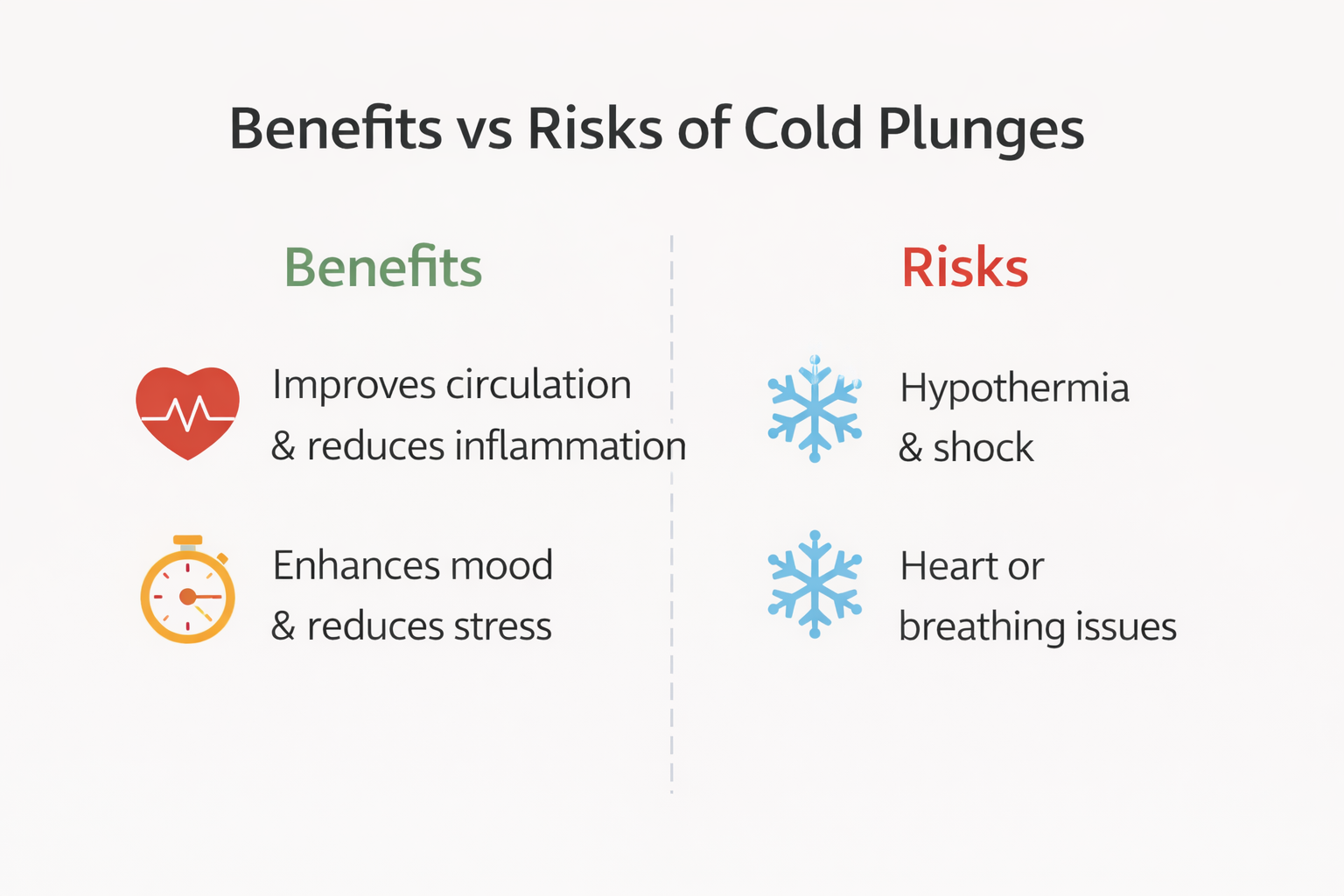
Cold Plunges & Ice Baths : Benefits vs Heart Risks
Quick Summary
Cold plunges and ice baths are everywhere—marketed as a shortcut to faster recovery, better mood, stronger immunity, and “mental toughness.” Some benefits are plausible (and many people genuinely enjoy the ritual), but the online narrative often skips the most important part: cold water triggers a powerful stress response that can raise blood pressure, spike heart workload, and—in higher-risk people—potentially trigger dangerous symptoms.
This post offers a balanced view: what cold exposure can realistically do, what’s likely overstated, and the key heart-related risks you should take seriously. You’ll also get a practical safety guide, including a gradual acclimation plan for beginners.
Health note: This article is general information, not medical advice. If you have heart disease, chest pain history, arrhythmias, uncontrolled high blood pressure, fainting episodes, or you’re unsure about your risk, talk with a clinician before doing cold plunges or ice baths.
Table of Contents
- Key Takeaways
- The Big Claims: Recovery, Mood, Immunity
- What Cold Exposure Can Realistically Do
- The Heart Risks People Don’t Talk About Enough
- Who Should Avoid Cold Plunges (or Get Cleared First)
- Safety Guide: How to Do It More Responsibly
- Beginner Protocol: Gradual Exposure Plan
- Benefits vs Risks: One-Page Decision Table
- FAQ
- Blog Optimization Info
Key Takeaways
- Cold plunges aren’t “free health.” They trigger a strong stress response—useful for some, risky for others.
- Recovery benefits can be real (especially soreness/comfort), but the “miracle cure” narrative is often overstated.
- Mood effects are common (alertness, “reset” feeling), but they don’t prove long-term mental health improvement.
- Immunity claims are frequently overhyped. Cold exposure is not a replacement for sleep, nutrition, vaccines, and basic hygiene.
- Heart risk is the main safety issue. Cold shock can raise blood pressure and provoke symptoms—especially in high-risk individuals.
- Gradual exposure beats bravado. Most safety problems come from “too cold, too long, too fast, alone.”
The Big Claims: Recovery, Mood, Immunity
Claim 1: “Ice baths speed up recovery.”
Cold water can reduce the sensation of soreness and can feel like it “calms down” post-workout inflammation. For many people, the biggest win is subjective: you feel better and more ready to train again. That said, recovery is more than soreness. If you’re training for muscle growth, some people prefer to avoid intense cold exposure immediately after strength sessions because it may interfere with adaptive signals. The practical takeaway: use cold strategically rather than automatically after every workout.
Claim 2: “Cold plunges fix anxiety and build mental toughness.”
Cold exposure often creates a strong sensation of alertness and a “wow, I did it” reward. This can reinforce consistency and confidence. But it can also become a dopamine loop: chasing bigger shocks or using cold as the only coping tool. If it helps you feel regulated, great—just don’t let it replace foundational mental health habits (sleep, therapy, boundaries, movement, relationships).
Claim 3: “Cold plunges boost immunity.”
This is where marketing often runs ahead of reality. Cold exposure may influence stress physiology, but immunity is complex and depends heavily on sleep quality, nutrition, illness exposure, chronic stress, and overall health status. If you’re using cold plunges as a “shield,” you may be overpaying attention to the wrong lever.
What Cold Exposure Can Realistically Do
- Short-term alertness: the cold shock response can make you feel energized and awake.
- Reduced perceived soreness: many people feel less “beat up” after a session.
- A consistent ritual: the routine can improve adherence to other healthy habits (sleep schedule, training consistency, mindfulness).
- Body awareness training: controlled breathing during discomfort can improve stress tolerance for some people.
Notice the pattern: many benefits are experience-based and behavioral. That’s not “fake”—it’s just different from the claim that cold plunges directly guarantee long-term health outcomes for everyone.
The Heart Risks People Don’t Talk About Enough
Cold water immersion can cause a rapid “cold shock” response. Even for healthy people, that can mean:
- Sudden gasp reflex and breathing rate increase
- Sympathetic surge (adrenaline/noradrenaline): heart rate and blood pressure can rise
- Peripheral vasoconstriction: blood vessels tighten, increasing the workload on the heart
In higher-risk individuals, these shifts can increase the chance of:
- Chest pain or pressure
- Heart rhythm disturbances (palpitations, irregular beats)
- Dizziness or fainting
- Dangerous breathing events if panic or hyperventilation occurs
Stop immediately and seek medical help if you experience chest pain/pressure, severe shortness of breath, fainting, confusion, new irregular heartbeat, or one-sided weakness/numbness.
Another overlooked risk is afterdrop: your core temperature can continue to fall after you get out, especially if you stay wet and exposed to cold air. The danger isn’t only in the tub—it can be in the minutes afterward if you underestimate rewarming.
Who Should Avoid Cold Plunges (or Get Cleared First)
Skip cold plunges (or get clinician clearance first) if any of these apply:
- Known heart disease (history of heart attack, angina, stents, heart failure)
- Uncontrolled high blood pressure or significant blood pressure variability
- Arrhythmias (atrial fibrillation, frequent palpitations, known rhythm disorders)
- History of fainting (especially unexplained syncope)
- Stroke history or significant vascular disease
- Pregnancy (individualized risk; discuss with a clinician)
- Panic/claustrophobia triggered by restricted breathing or shock sensations
- Alcohol or sedative use near the session (judgment and thermoregulation worsen)
- Illness with fever, chills, or respiratory distress
If you’re unsure where you land, the safest default is: start with cool showers and gradual exposure—and prioritize medical evaluation if you have red flags.
Safety Guide: How to Do It More Responsibly
1) Avoid “shock” sessions: go gradual
The number one safety upgrade is simple: don’t jump into extreme cold on day one. Adaptation is real, but it takes repeated, controlled exposure.
2) Never do it alone (especially early on)
Have someone nearby, or at minimum make sure someone knows what you’re doing and can check in. This is especially important if you’re experimenting with colder water or longer durations.
3) Keep your head out of the water
Head immersion increases the intensity of the shock response and can accelerate panic/hyperventilation.
4) Don’t hyperventilate
“Breathing hard to power through” can backfire. Aim for a calm exhale-focused rhythm. If you can’t control breathing, you’re not ready for that cold level.
5) Use time caps and a simple exit rule
Longer is not better. A conservative approach is safer and still effective for most people. Exit immediately if you feel:
- Dizziness, confusion, or “fading”
- Chest discomfort or unusual palpitations
- Numbness that feels intense or spreading
- Panic rising beyond control
6) Rewarm correctly
After you get out, dry off fast and rewarm with:
- Warm clothing layers
- Light movement (walking)
- Warm drink (not alcohol)
Avoid scalding-hot showers immediately if you feel lightheaded—use gentle warmth and steady rewarming.
Beginner Protocol: Gradual Exposure Plan
This plan is designed to reduce risk by controlling the two big variables: temperature and time. If you can’t breathe calmly, you’re going too hard.
Beginner Cold Exposure (2 Weeks)

Rule: Calm breathing is mandatory. Stop if you feel dizzy, panicked, or unwell.

Week 1 (Cool → Cold-ish)
- Day 1–2: Cool shower finish 15–30 seconds
- Day 3–4: Cool shower finish 30–45 seconds
- Day 5–7: Cool shower finish 45–60 seconds
Goal: Breathing control + consistency, not suffering.

Week 2 (Cold Water, Short)
- Day 8–10: Cold shower finish 60–90 seconds
- Day 11–12: Short cold plunge (very conservative time) OR continue showers
- Day 13–14: Repeat the easiest successful level

Notes:
- Keep head out of water.
- Never combine with alcohol/sedatives.
- Don’t do maximal cold on low-sleep / high-stress days.
If you want a “harder” protocol, earn it over weeks—not days. The goal is a safe habit, not a viral moment.
Benefits vs Risks: One-Page Decision Table
| Goal | Potential Upside | What’s Often Overhyped | Main Safety Concern | Best “First Step” |
|---|---|---|---|---|
| Workout recovery | Less perceived soreness; feels refreshing | “Always better recovery” for everyone | Cold shock stress; overuse | Use after endurance/competition; not mandatory after lifting |
| Mood/alertness | Short-term energizing effect | “Cures anxiety/depression” | Panic/hyperventilation | Try cool shower finishes + breathing control |
| Immunity | May support consistency and routine | “Prevents illness” as a direct effect | Overconfidence; ignoring basics | Sleep, nutrition, hygiene, vaccines as appropriate |
| Longevity / heart health | Indirect via habit stacking (exercise, stress skills) | “Guaranteed longevity boost” | BP spikes; arrhythmia risk in susceptible people | Medical clearance if risk factors + gradual exposure only |
FAQ
Is a cold plunge better than a cold shower?
A plunge is often more intense and can trigger a stronger shock response. A shower is easier to scale and can be safer for beginners. If you’re new or risk-uncertain, showers are a smart starting point.
How long should I stay in?
For most people, shorter is safer and still effective for the “feel” benefits. If you’re chasing long durations, that’s a sign you may be turning it into a challenge rather than a tool.
Can cold plunges be dangerous for healthy people?
Yes—especially with extreme cold, poor supervision, alcohol use, or pushing through panic. Healthy does not mean immune to cold shock effects.
What’s the safest way to start?
Cool shower finishes + controlled breathing + gradual progression. If you can’t control breathing, reduce intensity.
이 포스팅은 쿠팡 파트너스 활동의 일환으로, 이에 따른 일정액의 수수료를 제공받습니다.


