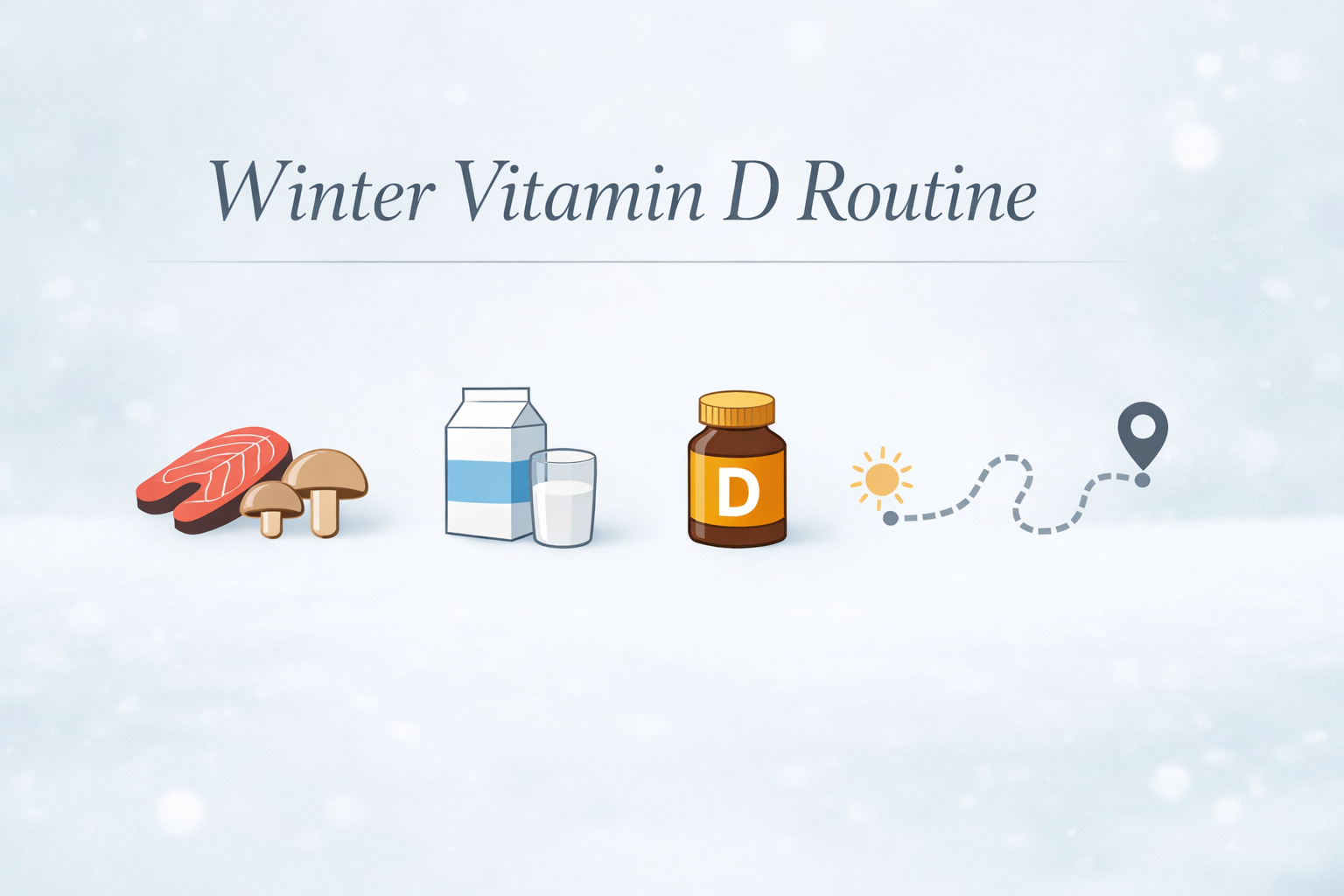
Winter Vitamin D: A Realistic “Low Sunlight Season” Routine (Diet + Supplements + Daily Routes)
In winter, many people spend more time indoors, days are shorter, and UVB—the part of sunlight that helps your skin make vitamin D—can be limited depending on latitude, time of day, and weather. Public-health guidance in several countries specifically highlights that sunlight may not be enough in darker months, which is why winter routines often rely on food choices and modest supplementation.
This post is designed for busy, real-life schedules. Instead of perfection, you will build a “minimum viable routine” that covers three pillars: food basics, safe supplement habits, and repeatable daylight routes.
Table of Contents
- Quick Summary
- Key Points (Numbers That Matter)
- Why Winter Feels Like a “Vitamin D Season”
- Diet: The High-Return Foods (and What They Realistically Provide)
- Supplements: A Safe, Simple Approach
- Lifestyle Routes: Daylight Without Overthinking It
- A 7-Day “Realistic Routine” Template
- Action Steps Checklist
- Extra Things to Consider
- Blog Optimization Info
Quick Summary
- Use winter as your “set-and-forget” season: keep vitamin D intake consistent rather than trying to fix it occasionally.
- Food helps, but for many people it is hard to reach recommended intakes from natural (non-fortified) foods alone, especially in winter.
- For generally healthy adults, many professional and public-health sources emphasize sticking close to established recommended intakes (RDA-type targets) and avoiding megadoses unless supervised.
- Build “daylight routes” that fit your day (commute, lunch break, weekend errands). Daylight can support routine consistency and well-being even when UVB is limited, but protect your skin and do not rely on tanning beds.
Key Points (Numbers That Matter)
- Unit conversion: 1 mcg of vitamin D equals 40 IU.
- Common adult target (U.S. RDA framework): 600 IU (15 mcg) daily for most adults, and 800 IU (20 mcg) daily for adults over 70.
- Upper limit (UL) for adults: 4,000 IU (100 mcg) per day, unless your clinician specifically advises otherwise for a medical reason.
- Winter supplement example (UK public-health style guidance): 10 mcg (400 IU) daily is often recommended during darker months for many people, especially when sunlight exposure is limited.
- Who should be extra careful: people with limited sun exposure, darker skin, fat-malabsorption conditions, obesity, older age, or certain medications may have different needs and should consider medical guidance.
Why Winter Feels Like a “Vitamin D Season”
Vitamin D is essential for bone health and normal calcium metabolism, and it is unique because sunlight can drive its production in the skin. In winter, multiple factors can reduce UVB exposure: shorter days, more time indoors, clothing coverage, cloud cover, and latitude/time-of-day effects. Some countries explicitly note that people may not make enough vitamin D from sunlight in autumn and winter.
At the same time, “more sun” is not a free pass. UV radiation is a carcinogen, and public agencies recommend photoprotection (including sunscreen). The realistic goal is not to chase sunburn or skip skin safety, but to create a steady routine that does not collapse when the weather gets cold.
Diet: The High-Return Foods (and What They Realistically Provide)
Only a few foods naturally contain meaningful vitamin D. Fortified foods (like fortified milk or plant milks) can contribute, but labels vary by country and product. The table below uses widely cited reference values to give you a sense of scale.
| Food (typical serving) | Vitamin D per serving | Practical takeaway |
|---|---|---|
| Cooked salmon, 3 oz | ~570 IU (14.2 mcg) | One serving can cover most of a typical daily target. |
| Cooked farmed rainbow trout, 3 oz | ~645 IU (16.2 mcg) | High-impact option if you like fish. |
| UV-exposed mushrooms, 1/2 cup | ~366 IU (9.2 mcg) | Great add-on, especially for plant-forward diets. |
| Fortified milk, 1 cup | ~120 IU (2.9 mcg) | Helpful, but usually not enough alone. |
| Fortified soy/almond/oat milk, 1 cup | ~100–144 IU (2.5–3.6 mcg) | Check the label; it varies by brand and region. |
| Egg, 1 large | ~44 IU (1.1 mcg) | Good nutrition, but not a major vitamin D source by itself. |
| Canned light tuna, 3 oz | ~40 IU (1.0 mcg) | Protein-friendly, but modest for vitamin D. |
Reality check: many people find it difficult to meet vitamin D needs from natural (non-fortified) foods alone, so fortified foods and/or supplements are common tools during winter.
Winter diet mini-rules (easy to follow)
- Pick one “anchor” food you genuinely like (for example, salmon once a week, or UV-exposed mushrooms a few times a week).
- Add one fortified staple you already buy (fortified milk or plant milk) and keep it consistent.
- If you rarely eat fish and do not use fortified foods, plan on a supplement habit rather than trying to “wing it” with food alone.
Supplements: A Safe, Simple Approach
Most over-the-counter vitamin D supplements contain either vitamin D2 or D3. Both raise blood levels, but evidence suggests vitamin D3 tends to raise and maintain levels more effectively than D2.
For generally healthy adults, recent guideline messaging emphasizes sticking to established recommended intakes (RDA-style targets) rather than routinely using high doses, and it does not encourage routine blood testing for everyone without a clear indication. If you suspect deficiency or have risk factors, discuss testing and dosing with a clinician.
“Keep it simple” dosing mindset
- Start with a modest daily supplement that helps you meet typical targets (often in the 400–800 IU range), then adjust only if a clinician advises it or if you have confirmed deficiency.
- Avoid stacking multiple products that each contain vitamin D (multivitamin + vitamin D + calcium blend), which can quietly push you toward higher totals.
- Do not exceed the adult UL of 4,000 IU/day without medical supervision.
Take it with food (for absorption)
Vitamin D is fat-soluble, and controlled research has found that taking vitamin D3 with a meal containing fat can increase absorption compared with a fat-free meal. The practical version: take your vitamin D with a normal meal, not on an empty stomach.
Safety notes you should not skip
- Vitamin D toxicity is rare but can occur with excessive supplement intake and may lead to high calcium levels and serious problems; this is why the UL exists.
- Some medications and conditions can change vitamin D needs or risks (examples include certain weight-loss drugs, steroids, and thiazide diuretics). If you take long-term medications, ask your pharmacist or clinician before increasing doses.
Lifestyle Routes: Daylight Without Overthinking It
Think of daylight as a “route habit,” not a “sunbathing project.” In winter, UVB can be limited, but stepping outside still helps you build consistency, move your body, and anchor your day. Keep skin safety in mind: UV exposure raises skin cancer risk, and photoprotection is recommended when exposed to sun.
Three routes that fit most schedules
- Route 1 (Morning anchor, 5–10 minutes): step outside after waking (or after your first meeting) for a short walk around the block or to a nearby café.
- Route 2 (Lunch daylight, 10–20 minutes): schedule a brief walk before or after lunch; treat it like an appointment.
- Route 3 (Weekend reset, 30–60 minutes): do one longer outdoor errand loop (market, park, museum walk) to maintain the habit when weekdays are tight.
What not to do
- Do not use tanning beds as a “vitamin D tool.” Artificial UV exposure can drive very high blood levels and carries clear health risks.
- Do not chase extreme sun exposure to “make up” for missed days; supplementation is the safer lever when needed.
A 7-Day “Realistic Routine” Template
This template is intentionally flexible. You can repeat it weekly and scale it up or down depending on your schedule and diet.
| Day | Diet focus | Supplement habit | Daylight route |
|---|---|---|---|
| Mon | Fortified milk/plant milk with breakfast | Take with dinner (with fat-containing meal) | 10-minute lunch walk |
| Tue | Egg-based breakfast (supporting role) | Same time as Mon | 5-minute morning step-out |
| Wed | UV-exposed mushrooms added to a meal | Same time as Mon | 10–20 minute daylight loop (errands) |
| Thu | Fortified staple again (keep it consistent) | Same time as Mon | Short outdoor call (walk while listening) |
| Fri | Fish meal (salmon or trout if possible) | Optional if diet already high that day (stay within your plan) | 10-minute lunch walk |
| Sat | Simple protein + vegetables; keep sugar low | Same time as Mon | 30–60 minute outdoor reset route |
| Sun | Meal prep with mushrooms/fortified staples | Same time as Mon | Light afternoon walk, early bedtime |
Reference numbers for food vitamin D amounts and recommended intakes are based on widely used public-health reference tables.
Action Steps Checklist
- Pick one weekly “high-return” vitamin D food (salmon/trout or UV-exposed mushrooms) and schedule it.
- Add one fortified staple you already buy (milk or plant milk) and use it consistently.
- If you use supplements, choose a modest daily dose aligned with recommended intakes and take it with a meal.
- Check your total daily intake across all products and stay below the adult UL unless medically directed.
- Build one daylight route into your weekday schedule and one longer route on weekends.
- If you have risk factors (limited sun exposure, darker skin, malabsorption, obesity, older age, or relevant medications), consider clinician guidance about testing and dosing.
Extra Things to Consider
- Do not overpromise benefits: vitamin D has clear roles in bone health, but evidence is mixed or insufficient for many other claimed outcomes; keep your expectations grounded.
- Routine beats intensity: a small daily habit (supplement + daylight route) is more reliable than occasional “catch-up” behavior.
- If you feel unwell: fatigue and low mood can have many causes. If you suspect deficiency or have symptoms, consult a healthcare professional rather than self-treating with high doses.
This post contains affiliate links, and I may earn a commission if you make a purchase through them.


